

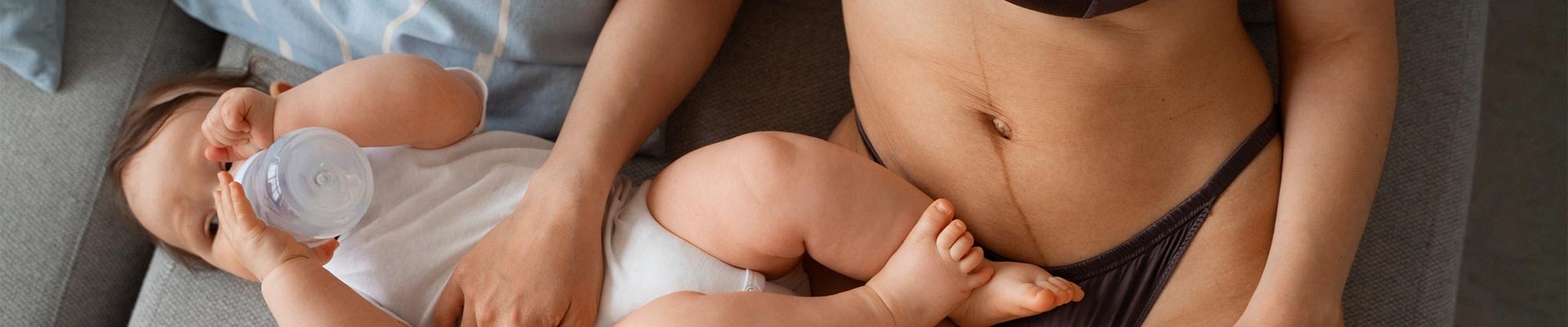
Postpartum Belly
Pregnancy and motherhood are special, magical periods in a woman’s life, filled with joy and tenderness. However, after childbirth, the body undergoes significant changes that can affect appearance.
Most often, new mothers are concerned about a postpartum belly—skin stretching, weakened muscles, the appearance of fat deposits, or even diastasis of the rectus abdominis muscles. Fortunately, modern cosmetology offers effective methods that, when combined with permitted physical activity, massage, a balanced diet, and skincare products, help accelerate skin recovery, strengthen tissues, restore an aesthetic, firm appearance, and achieve a flatter abdomen after childbirth more quickly.
Why Does the Belly Remain After Childbirth?
The belly after pregnancy and childbirth does not disappear instantly—and this is completely natural. During pregnancy, the body undergoes significant changes: the abdominal muscles stretch to create space for the growing baby, and the skin loses its former elasticity. In addition, hormonal balance remains unstable for some time, which affects metabolism and tissue recovery processes.
Among the main reasons why women have a sagging belly after childbirth are:
- diastasis of the rectus abdominis muscles — separation of the muscles that causes the abdomen to appear protruding;
- temporary muscle weakness and stretched abdominal skin after childbirth — even after the baby is born, the abdominal wall needs time to tighten;
- fat accumulation in the waist and abdominal area — a natural response of the body as it prepares for breastfeeding after delivery;
- decreased levels of collagen and elastin — the abdominal skin becomes less firm after childbirth;
- postural changes and weakened core muscles — during pregnancy, the center of gravity shifts, which affects the shape of the abdomen.
Thus, a postpartum belly is not only an aesthetic concern but also the result of physiological changes that require a comprehensive recovery approach. How long it takes for the belly to go down after childbirth depends on a woman’s individual factors—primarily her lifestyle before pregnancy and delivery, her ability to recover, and her willingness and opportunity to take a comprehensive approach to rehabilitation and abdominal skin tightening.
Why Does Abdominal Skin Sag After Childbirth?
Sagging skin and stretch marks on the abdomen after pregnancy and childbirth are natural processes associated with the fact that during pregnancy, tissues stretch over a short period of time to accommodate the growing belly. Collagen and elastin fibers, which are responsible for the skin’s firmness and density, are partially damaged in the process. After childbirth, the skin does not always tighten back quickly, especially if:
- pregnancy was accompanied by rapid or significant weight gain;
- there was a multiple pregnancy or a large baby;
- the woman is over 30, when natural collagen production decreases;
- there was insufficient abdominal skincare during pregnancy;
- there was rapid weight loss after childbirth.
In addition, hormonal changes slow down regeneration processes, which is why tightening the abdominal skin requires time, hydration, and stimulation. That is why postpartum cosmetology procedures aimed at restoring tone, improving microcirculation, and stimulating collagen synthesis help restore firmness and smoothness to the abdomen.
When Does the Belly Go Away After Childbirth?
Almost all new mothers wonder how to restore their belly after childbirth. However, recovery timelines differ for every woman. On average, noticeable recovery and tightening of the abdomen begin after 2–3 months, while a full return of tone may take up to a year. It all depends on the individual characteristics of the body and the young mother’s lifestyle.
The following factors influence recovery time:
- genetics — natural elasticity and metabolic rate depend on heredity;
- type of delivery — after a cesarean section, abdominal regeneration usually takes longer;
- presence of diastasis — when the abdominal muscles separate, the belly remains protruding for a longer time;
- physical activity — regular but safe exercises help strengthen the abdominal muscles faster;
- nutrition — a balanced diet with sufficient protein, vitamins, and water supports the skin and abdominal muscles;
- body care — abdominal massages, tightening creams with collagen, and cosmetic procedures stimulate recovery;
- breastfeeding — promotes uterine contraction and partial reduction of the abdomen.
Thus, the disappearance of a postpartum belly is a gradual process that requires patience, comprehensive care, and attentiveness to one’s body.
When Can You Start Restoring the Abdomen After Childbirth?
Abdominal recovery after childbirth should begin carefully and gradually, taking into account the condition of the body and the doctor’s recommendations.
- After a vaginal delivery, light breathing exercises, gentle abdominal engagement, and muscle relaxation can be started as early as 2–3 weeks postpartum, provided there is no pain or complications.
- After a cesarean section, any physical activity should be postponed for at least 6–8 weeks, until the abdominal scar has fully healed and the abdominal wall has recovered.
Before starting active workouts, it is important to make sure there is no diastasis (separation of the rectus abdominis muscles). If diastasis is present, regular abdominal exercises may worsen the condition. In such cases, special therapeutic exercises under the supervision of a postpartum rehabilitation specialist are recommended.
It is also important to pay attention to overall well-being—if pain, dizziness, or weakness occur, training should be stopped. Ideally, physical exercises should be combined with proper nutrition, body care, and, if necessary, cosmetology procedures for comprehensive abdominal recovery.
How to Get Rid of a Postpartum Belly?
To effectively get rid of a postpartum belly, a comprehensive approach is required, as only a combination of different methods provides lasting results. Physical exercise or diet alone is not enough—it is important to work simultaneously with the abdominal muscles, the skin, and metabolism. The foundation includes moderate physical activity, balanced nutrition, regular body care, and modern cosmetology procedures that accelerate regeneration and skin tightening. It is the грамотне (well-planned) combination of these measures that helps restore abdominal tone, reduce volume, and bring back harmonious body contours after childbirth.
It is recommended to consult a specialist who can advise on how to tighten the abdomen after childbirth without the risk of complications. In our clinic, these are cosmetologist physicians. After the consultation, the cosmetologist will recommend a procedure that will speed up recovery and abdominal tightening after childbirth...
ICOONE Laser
ICOONE Laser is an innovative device-based treatment that combines vacuum-roller massage, microstimulation, and laser energy. The treatment targets deep layers, including the subcutaneous fat tissue. The procedure activates lymphatic drainage, microcirculation, and collagen synthesis, thereby reducing swelling and improving tissue tone and firmness.
Helps with: skin laxity, cellulite, localized fat deposits, and postpartum stretch marks.
Result: visibly tightened abdominal contours, a smooth belly without puffiness or the appearance of orange-peel skin.
BI-ONE Life Touch Therapy
BI-ONE Life Touch Therapy is a device-based bioenergetic method that combines microcurrent stimulation with bioresonance therapy. It works at the cellular level, improving energy metabolism and supporting tissue recovery after pregnancy.
Helps with: weakened abdominal muscles, swelling, stagnant processes, and loss of tone.
Result: restored firmness, improved microcirculation, and a smooth, toned abdomen.
Microneedling RF Lifting Morpheus8
Morpheus8 combines radiofrequency (RF) heating with microneedling stimulation, allowing deep treatment of the skin and subcutaneous structures. Microneedles deliver thermal energy into the dermis, triggering the synthesis of new collagen and elastin.
Helps with: stretch marks, skin laxity, and postpartum skin ptosis (sagging).
Result: noticeable skin tightening, lifting, reduced depth of stretch marks, and improved texture and tone of the abdominal skin.
Endolift
Endolift is a minimally invasive laser procedure performed using a thin optical fiber. The laser beam targets collagen fibers and subcutaneous fat, producing an immediate lifting effect and tissue remodeling.
Helps with: excess fat layer, sagging, and skin laxity after weight loss or childbirth.
Result: a more defined abdominal contour, reduced volume, and firm, tightened skin without surgical plastic procedures, incisions, or scars.
SMAS Lifting Ultraformer MPT
Ultraformer MPT is a next-generation ultrasound SMAS lifting procedure that works at a depth of up to 4.5 mm, targeting the superficial musculoaponeurotic system (SMAS). Ultrasound pulses create micro-injuries that stimulate collagen fiber contraction and the formation of new collagen.
Helps with: skin laxity, ptosis, and loss of abdominal tone after childbirth.
Result: a lifting effect without surgery, firmer abdominal skin, and improved elasticity and structure.
SMAS Lifting Ulthera Therapy
Ulthera Therapy is the gold standard of ultrasound lifting, acting on the same tissue depths as surgical lifting but without surgery. The technology precisely targets problem areas, creating focused thermal points in deep layers that stimulate neocollagenesis.
Helps with: sagging, thin skin, and age-related or postpartum ptosis.
Result: pronounced lifting, firmer abdominal skin, improved contours, and a long-lasting lifting effect.
If you want to know how to get rid of a postpartum belly, don’t face this issue alone. Schedule a consultation at LeoDerm Clinic in Lviv, where cosmetologist physicians will create an individualized aesthetic recovery program for you. It is important to understand that cosmetology cannot address issues such as diastasis removal. However, for concerns like abdominal skin laxity, cellulite, stubborn fat deposits, and stretch marks, cosmetic procedures significantly support recovery and help you get closer to your desired result.
If you experience symptoms of an illness, please consult a doctor.